
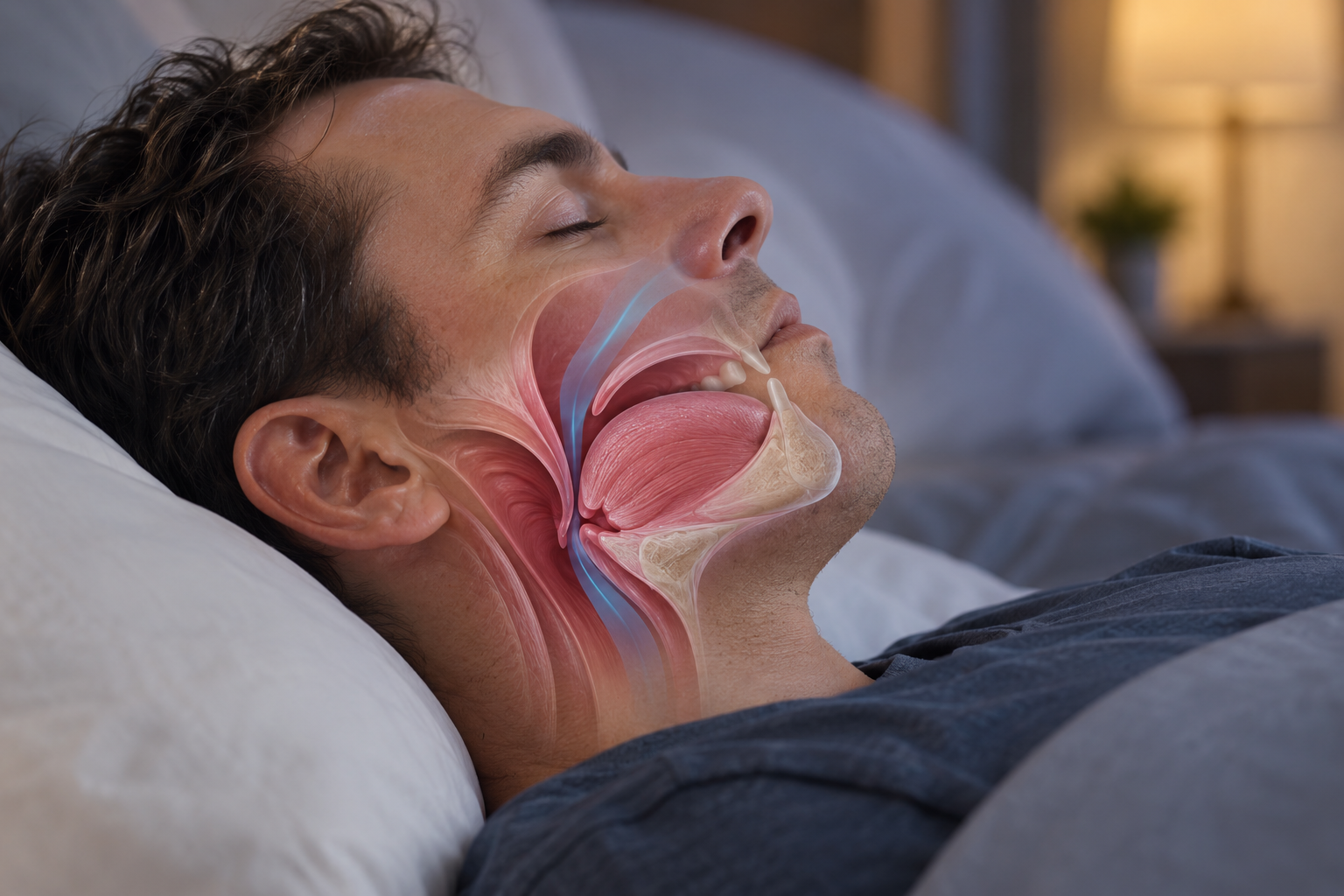
Many people who grind or clench their teeth at night are told that stress is probably the reason. Stress can contribute, but sleep bruxism is more complicated than that. Jaw muscle activity can occur around brief arousals from sleep, and obstructive sleep apnea can also cause repeated arousals as the body responds to restricted breathing.
That overlap has led researchers to ask an important question: can nighttime grinding be a clue that something is happening with the airway during sleep?
The most accurate answer is that it can be one piece of the picture, but grinding by itself does not diagnose sleep apnea.
Why researchers are looking at bruxism and sleep apnea together
Sleep bruxism is repetitive jaw muscle activity that occurs during sleep. It may involve grinding the teeth, clenching, or bracing the jaw. Obstructive sleep apnea is a separate medical condition in which the upper airway repeatedly narrows or closes during sleep, disrupting breathing and sleep quality.
Both conditions can occur around brief arousals. During an obstructive breathing event, the nervous system may activate as the body works to restore airflow. Jaw muscle activity can also occur during or around these periods. That timing is one reason researchers continue to study a possible relationship between sleep bruxism and obstructive sleep apnea.
What does the newest research show?
The research is interesting, but it does not support a simple statement that one condition causes the other.
A 2025 systematic review evaluated 11 studies published from 2020 through 2025. Sleep bruxism was reported more often in people with obstructive sleep apnea than in the general population. The authors described possible shared mechanisms involving autonomic arousals and nervous system activity, but they also emphasized that differences in diagnostic methods limited the strength of the conclusions.
A 2026 umbrella review examined previous systematic reviews and again found evidence that obstructive sleep apnea and sleep bruxism can coexist. Most of the included reviews reported frequent coexistence, possibly related to micro arousals and autonomic activation. However, the authors concluded that the evidence remains heterogeneous and limited, and that causality is still unclear.
An earlier 2024 systematic review and pooled analysis did not find a statistically significant increase in sleep bruxism among people with obstructive sleep apnea. That study also noted that the quality of much of the available evidence was low. Taken together, the research supports continued investigation rather than assuming that grinding automatically means sleep apnea.
The practical takeaway is that significant nighttime grinding may be one more clue worth considering when other symptoms of sleep apnea are present.
What happens when the airway becomes restricted during sleep?
The sleeping body has protective responses that can help restore breathing. An obstructive event may trigger autonomic activation and a brief arousal. Activity can increase in muscles that help support the upper airway. The tongue may reposition, swallowing can occur, and the lower jaw may move as breathing is restored.
In some people, increased jaw muscle activity, clenching, or grinding can occur around these respiratory events and arousals. This does not mean that every grinding episode is an airway rescue response. It does help explain why clinicians are interested in the timing of breathing events, arousals, and jaw activity during sleep.
What symptoms make the airway question more important?
Grinding alone is not enough to assume someone has obstructive sleep apnea. The concern becomes more meaningful when it occurs alongside symptoms or risk factors such as:
- Loud or frequent snoring
- Witnessed pauses in breathing
- Waking up choking or gasping
- Morning headaches
- Dry mouth on waking
- Unrefreshing sleep
- Excessive daytime sleepiness or fatigue
- High blood pressure
- A previous diagnosis or concern for sleep apnea
If those symptoms are present, the more useful question is not simply whether someone grinds. It is whether breathing during sleep should be evaluated.
A mouthguard does not tell us what the airway is doing
A conventional mouthguard may reduce the effects of grinding, but it is not a test for obstructive sleep apnea and it is not designed to determine whether breathing is being disrupted during sleep.
A custom oral appliance used to treat obstructive sleep apnea has a different purpose. It is designed to position the lower jaw in a way that can help maintain the airway during sleep. When oral appliance therapy is used for diagnosed obstructive sleep apnea, treatment should include appropriate medical involvement, adjustment, and follow up testing to determine whether breathing has actually improved.
How sleep apnea is actually diagnosed
Grinding, snoring, tongue size, tooth wear, or the appearance of the throat cannot diagnose obstructive sleep apnea by themselves. Diagnosis requires an appropriate medical evaluation and objective sleep testing.
The American Academy of Sleep Medicine states that obstructive sleep apnea is a medical diagnosis. For selected uncomplicated adults with signs and symptoms that indicate an increased risk of moderate to severe obstructive sleep apnea, a home sleep apnea test can be an alternative to laboratory polysomnography when appropriately ordered and interpreted. The test results must be considered along with the patient’s medical history, symptoms, and clinical evaluation.
If you are not sure where to begin, our guide to home sleep testing explains the basic options. You can also read more about the difference between snoring and sleep apnea.
If sleep apnea is found, treatment should be individualized
There is no single treatment that is right for every person with obstructive sleep apnea. CPAP is an important and highly effective option. For appropriate patients, a custom oral appliance can also be considered, particularly when a patient prefers an alternative or has difficulty using CPAP consistently.
The important part is not simply choosing a device. It is confirming that the treatment works for that individual. Follow up sleep testing is important because feeling better or snoring less does not necessarily prove that obstructive breathing events have been adequately controlled.
You can learn more in our comparison of oral appliance therapy and CPAP.
Dr. Dawson’s Two Cents
When airflow becomes restricted during sleep, the body can respond with a series of rescue responses. We may briefly arouse, increase activity in the muscles that help hold the airway open, swallow, reposition the tongue, or move the lower jaw as breathing is restored. In some people, increased jaw muscle activity, clenching, or grinding can occur around these events. Sometimes we can see clues of that repeated activity in the mouth, including patterns of wear on the teeth, but those clues cannot diagnose sleep apnea or tell us how severe it may be. They are simply pieces of the overall picture. The most important question is what is actually happening to breathing during sleep. An appropriate sleep study gives us the objective information needed to answer that.
Should you get evaluated?
If you grind or clench but otherwise sleep well and have no symptoms of sleep related breathing problems, bruxism alone does not mean you should assume you have obstructive sleep apnea.
If grinding occurs along with loud snoring, witnessed breathing pauses, gasping, persistent fatigue, morning headaches, or a previous concern about sleep apnea, it may be reasonable to discuss sleep testing with an appropriate medical provider.
Restful Sleep Center helps patients understand their options, coordinate appropriate testing and physician involvement, and, when indicated, provide custom oral appliance therapy with follow up to determine whether treatment is working. If you are unsure where to begin, visit our Getting Started page or call (623) 566-1310.
References
- García Doblado N, Barrera Mora JM, Pastor Dorado F, et al. Relationship Between Bruxism and Obstructive Sleep Apnea: A Systematic Review of the Literature. Journal of Clinical Medicine. 2025;14(14):5013.
- Pereira KK, Pereira IF, Machado Júnior AJ. Possible association between obstructive sleep apnea syndrome and sleep bruxism in adults: an umbrella review. Sleep Medicine. 2026;147:109129. Published online July 9, 2026.
- Błaszczyk B, Waliszewska Prosół M, Więckiewicz M, et al. Sleep bruxism may be not associated with obstructive sleep apnea: A comprehensive assessment employing a systematic review and meta-analysis. Sleep Medicine Reviews. 2024. doi:10.1016/j.smrv.2024.101994.
- American Academy of Sleep Medicine. Clinical use of a home sleep apnea test: An updated American Academy of Sleep Medicine position statement. Updated May 1, 2025.
This article is for general educational purposes and is not a diagnosis. Sleep bruxism, snoring, tooth wear, or oral anatomy alone cannot diagnose obstructive sleep apnea. Appropriate medical evaluation and sleep testing are needed when obstructive sleep apnea is suspected.